
In case you haven’t noticed, gas and diesel prices are up this year. Here in Ohio, the state average gasoline price is about $4.45 a gallon. Diesel is $6.82/gal. The main cause is simple: Crude oil is around $100 a barrel because of the war with Iran and disruptions in the Strait of Hormuz. Here in the Midwest, fuel price pressures are compounded by flooding issues at a refinery in Joliet, IL.
Politicians in Columbus and Washington have responded with the same idea: suspend the gas tax. Amy Acton and Vivek Ramaswamy have both called for suspending Ohio’s 38.5-cent gasoline tax and 47-cent diesel tax for 90 days. Right now, it seems like the Ohio House may vote on a plan as early as September 30.
In this post, I try to put some numbers behind what such a tax holiday would do, informed by simple economics and previous literature. I then discuss who in Ohio would benefit most from such a policy and why the gas tax holiday is inferior to simply writing an equivalent check to Ohioans. First, though, I need to know what’s on the table and how much it would cost.
What is on the table
Recent data suggests that suspending Ohio motor fuel taxes for 90 days would cost the state about $640 million in lost revenues.1 About $450 million of that would come from the gasoline tax relief, and another $190 million would come from the diesel tax.
In total, motor fuel taxes raised about $2.7 billion in fiscal year 2025. About 36% went to cities, counties, and townships, and most of the rest funds ODOT, where it makes up about 86% of the department’s state revenue and about a third of its total revenue, including federal aid. That means about $230 million of the $640 million would come out of local road budgets unless the state backfills the funds.
I won’t opine on the likelihood that this policy proposal goes through, except to note that Governor DeWine opposed a suspension in 2022 and again this spring. However, he said this week that he is waiting to see the details of the latest proposal before taking a stand.
Most of the tax cut will probably reach the pump
Whether a tax cut lowers prices depends on, you guessed it, how supply and demand adjust. In general, US drivers don't change how much they buy much when prices move, at least in the short run. We all still need to get to work, drive to the store, and go shopping. You can see this in national VMT statistics. Even with the big spike in gas prices, driving didn’t really change from 2025 to 2026.
With demand that unresponsive, the supply side largely decides whether Ohio drivers benefit from the tax cuts. If sellers can bring in more gallons into Ohio at close to the same cost, competition pushes prices down by nearly the full tax.
This is shown in the figure below. For those who have taken introductory microeconomics, a tax cut on firms shows up as a shift down in the supply function (the dashed line → blue solid line). The vertical gap is the amount of the tax cut, but the intersection of supply and demand determines the equilibrium fuel price. In the graph below, taxes are cut by 38.5 cents/gal (the vertical gap), and gas prices decline by 29 cents/gal (the two equilibrium prices).
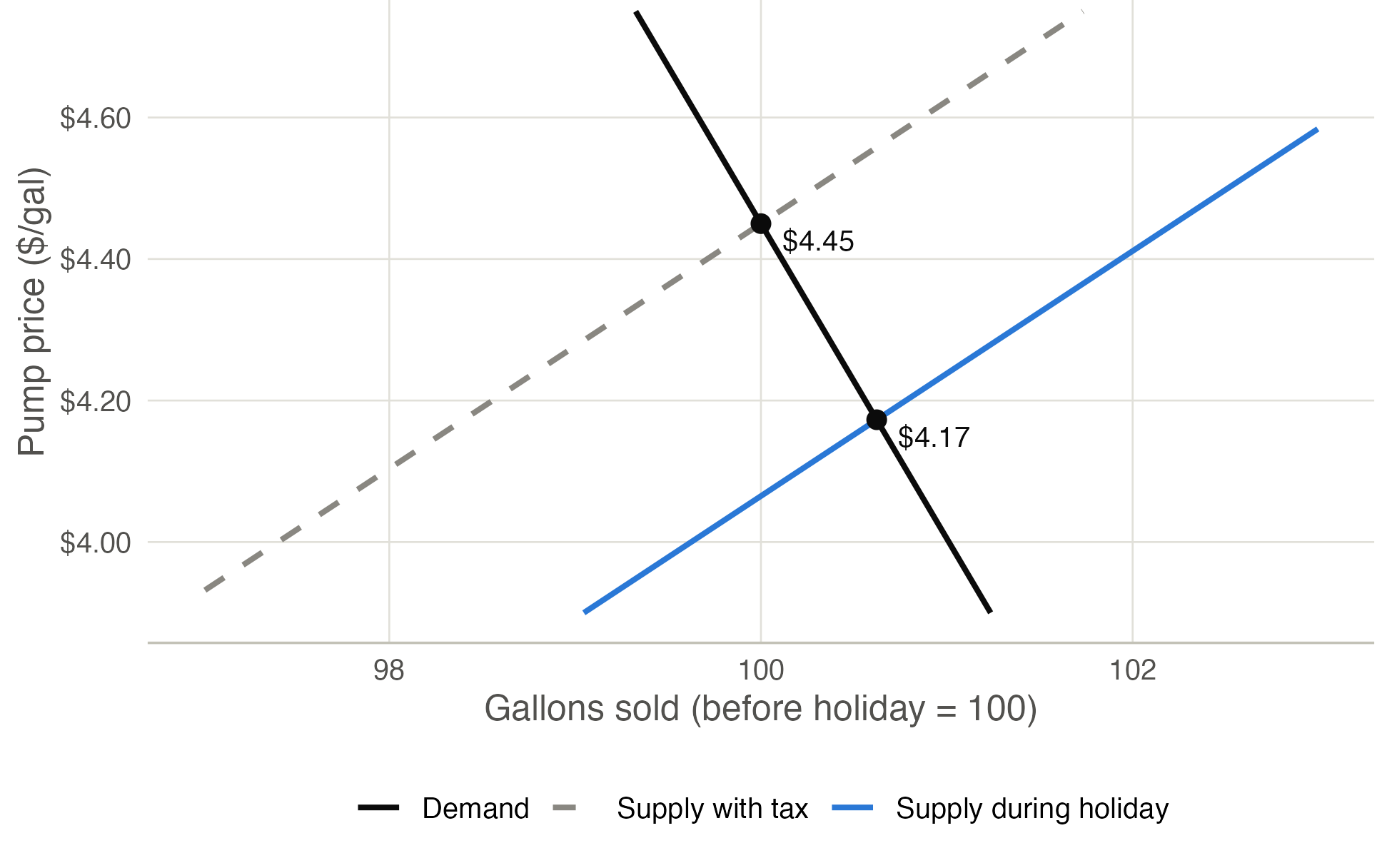
Why don’t prices come down by the full amount of the tax cut? Mostly because it typically costs more to deliver higher fuel supplies to the state to cover increased demand from the cut. Some of the cut stays with stations and distributors as higher margins.
Wait, didn’t I just say that gas demand doesn’t move much when prices change? Yup, Ohioans may not drive much more even if prices come down, but you can bet that folks near the borders of neighboring states will start to make some extra trips to fuel up in Ohio if we go it alone with the gas tax holiday. Interstate and regional truckers will also strategically refill in the state.
The figure above isn’t just theoretical. Economists have studied impacts of past temporary gas tax holidays. They confirm that most of a state cut reaches the pump. [Note: Things would be very different if we were talking about a federal gas tax holiday.]
When Illinois and Indiana suspended their gasoline sales taxes in 2000, about 70% of the tax cuts showed up as lower prices within a week. Across the 2022 holidays in Connecticut, Georgia, Maryland, and New York, a recent study estimates an average price decrease of 79% of the value of the tax cuts. Values ranged across states, though, from about 40% to full pass-through, depending on the state.
The figure above and my subsequent analyses use 72% as a central case and show 50% and 100% as alternatives.
Who in Ohio benefits
OK, so I’ve estimated total fuel volumes, how much of the tax holiday would pass through to consumers, and the policy's total cost. What about who would benefit the most from the tax holiday?
To estimate who benefits, I pulled federal survey data on how much Midwest households spend on gasoline, along with Census data on the income, vehicles, size, and age of Ohio households. This gives me an estimate of each Ohio household’s gasoline and diesel use.2
After a few calculations, I estimate that the average Ohio household would save about $51 over the 90-day holiday. The range runs from $35 if half the cut reaches the pump to $70 if all of it does.
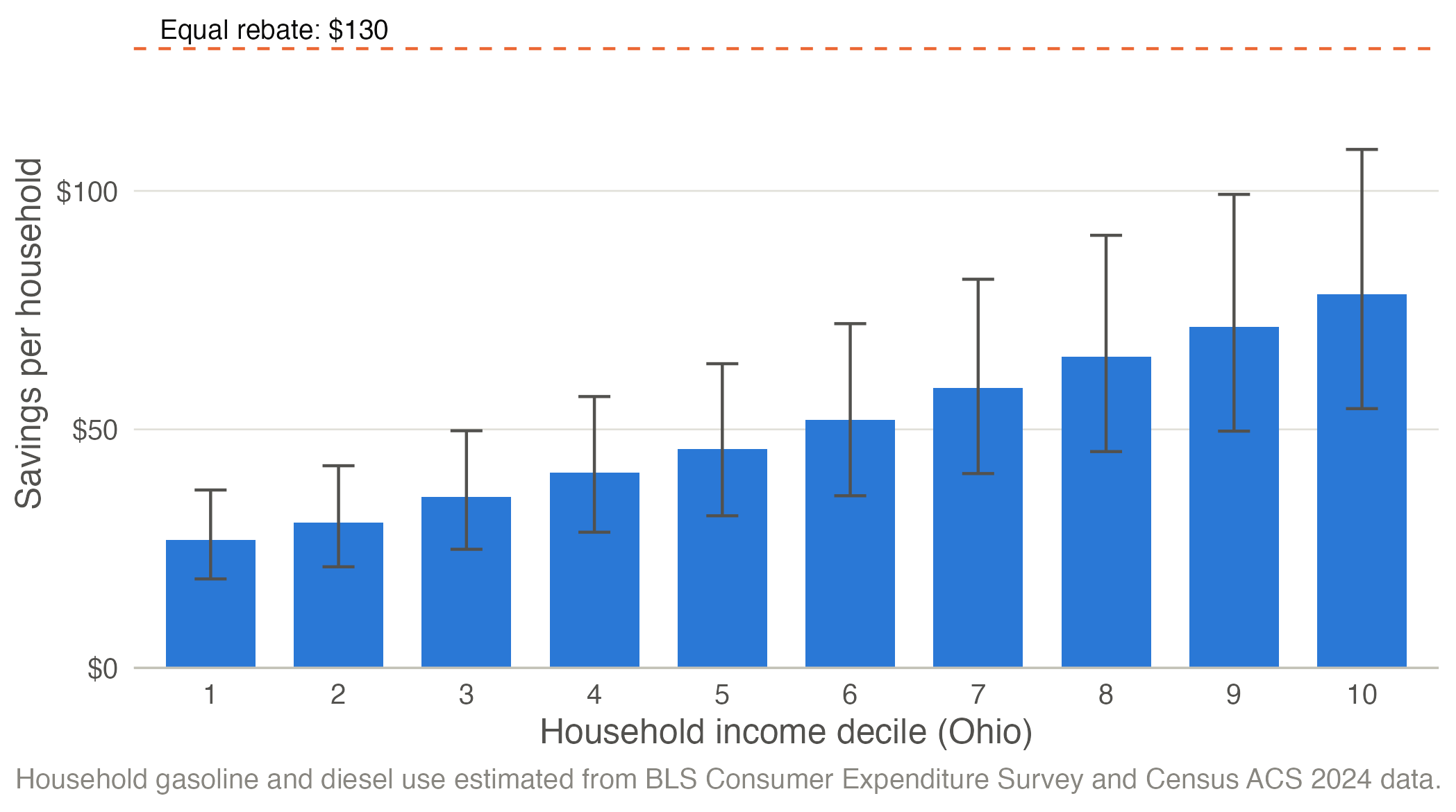
I can perform the same calculations by income decile. The benefits of a gas tax holiday increase as households’ incomes increase. Households in the lowest income tenth would save about $27, and those in the highest tenth about $78. Why? Higher-income households own more vehicles and drive more. That’s total savings, though. Relative to income, the pattern reverses. The holiday is worth about 0.3% of income for the lowest-income households and 0.02% for the highest.
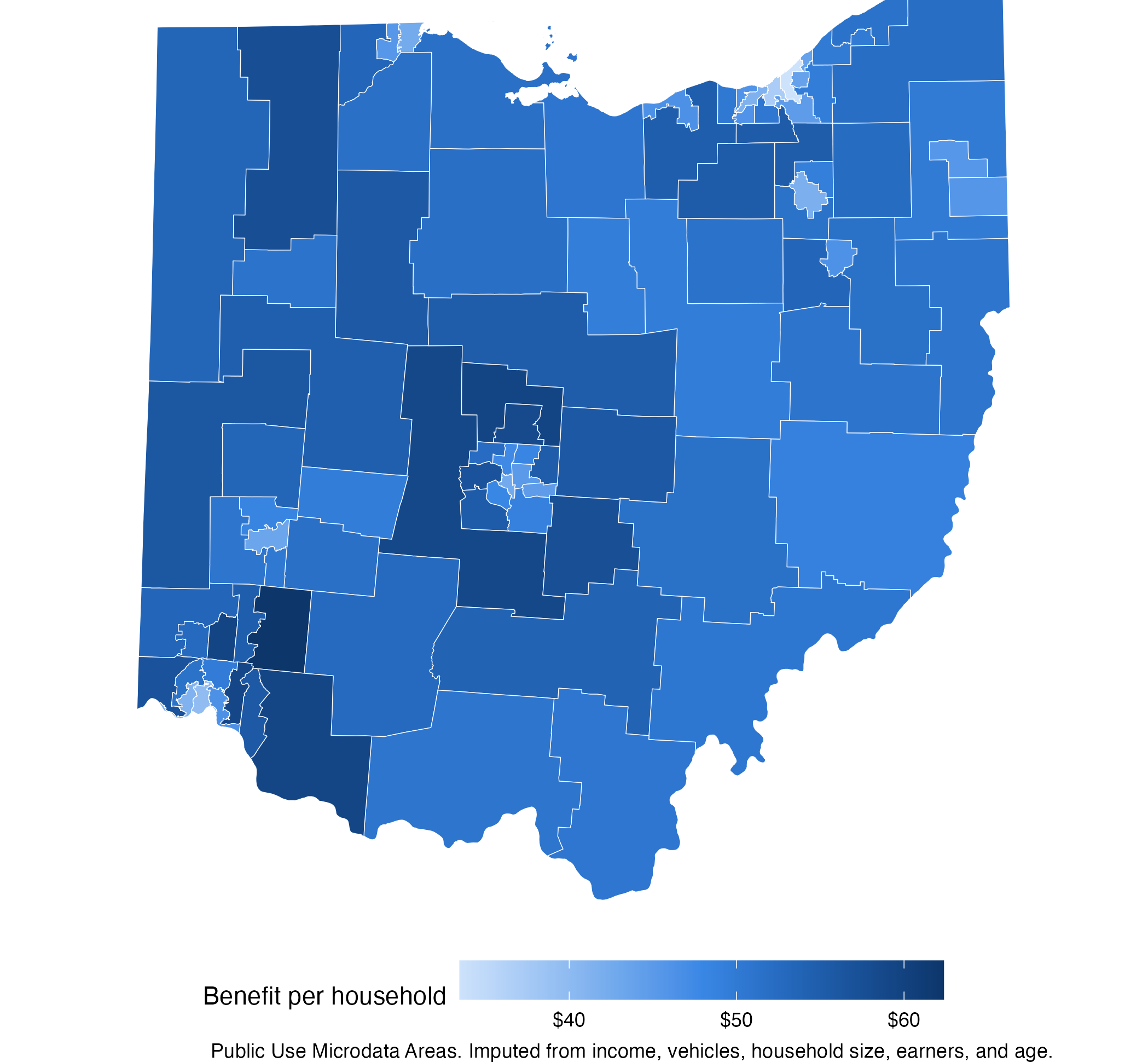
Performing the same calculations, but breaking them up by region of the state shows that households outside Ohio’s big cities come out slightly ahead. Households in rural areas would save about $53 and those in mixed suburban and small-town areas about $54, compared with $48 in urban areas.
The gap is modest, and reflects differences in vehicle ownership and household makeup. (I do not have data on commuting distance - a key limitation of this exercise.) Rural Ohioans who drive farther than similar households elsewhere would save more than my estimates suggest. The lowest savings are in the central neighborhoods of Cleveland, Columbus, and Cincinnati, where many households do not own a car.
It’s not just households that would benefit from the gas tax holiday, though. Households buy about 75% of Ohio’s taxed gasoline and about 4% of its taxed diesel. The rest is bought by businesses, government fleets, trucking companies, and out-of-state drivers.
The figure below splits the holiday’s cost among recipients.3 Under the central case, Ohio households directly receive about 39% of the $640 million, other gasoline and diesel buyers receive about 29%, and refiners and retailers keep the remaining $202 million. The sellers’ share is simply what is left once I assume how much of the cut reaches the pump. It falls to about $32 million if the gasoline cut passes through fully and rises to about $336 million if only half does.
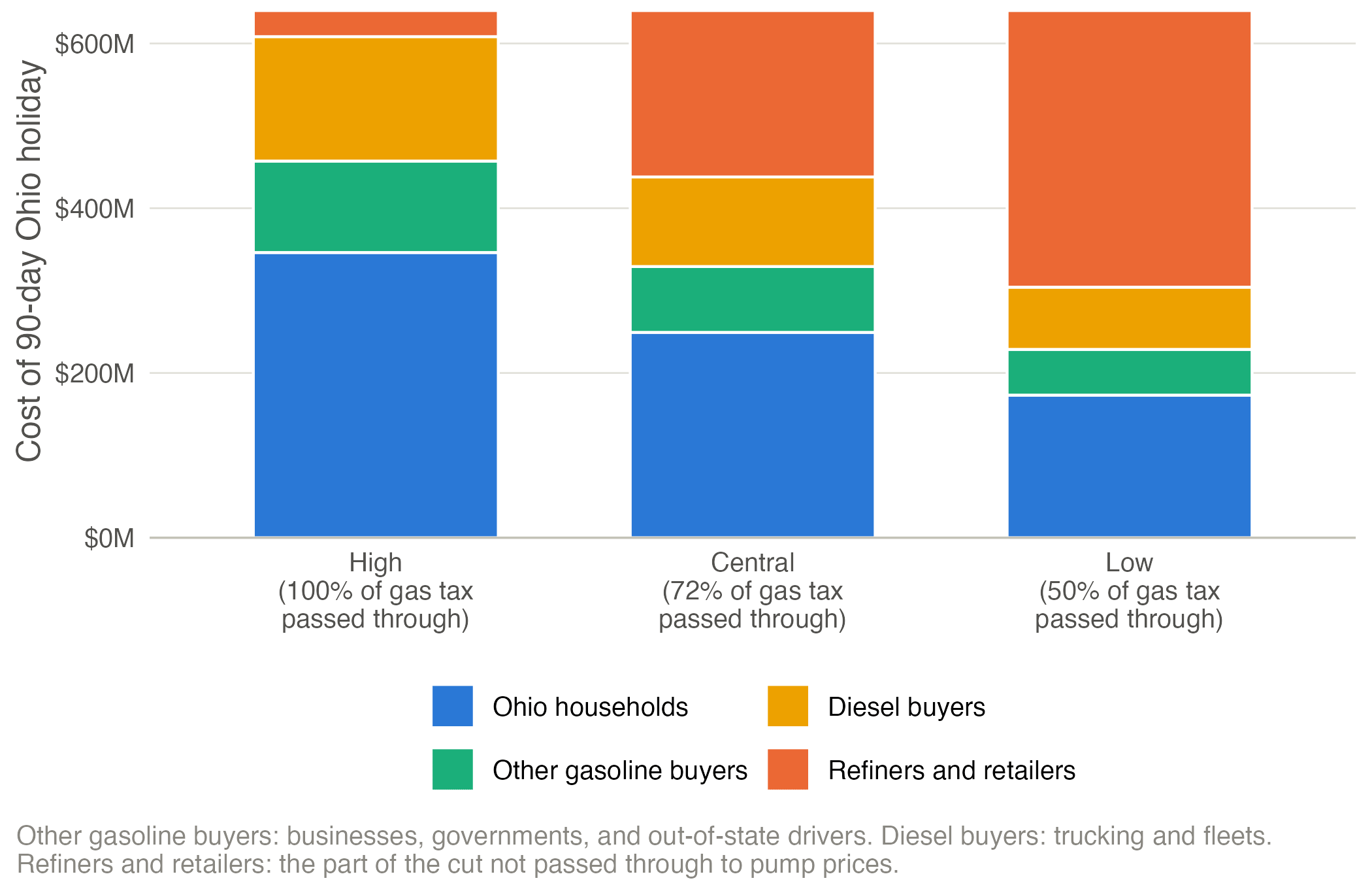
Yes, some of the money going to businesses will eventually reach Ohio consumers through lower shipping and delivery costs. But that channel is slow and diffuse, so I am not considering it here.
A simpler proposal
If I understand the gubernatorial candidates' sentiment right, they are concerned about Ohio households’ financial well-being.
If that is really the case, a much more direct way to help Ohio households is to just send $640 million worth of checks to households. Ohio has about 4.9 million households, so $640 million would afford to send about $130/household, substantially higher than what would reach the households with a gas tax holiday. If candidates are worried about lower-income households or households in certain areas of the state, they could target these payments, giving more to certain households than others.
In sum, a gas tax holiday would visibly lower Ohio pump prices, but only about four of every ten dollars it costs would reach Ohio households directly. A direct payment would deliver more to Ohio households for the same money. It would also make the price tag more visible, which may be why it is less popular than a cut at the pump.
In 2023, Ohio taxed 4.77 billion gallons of gasoline and 1.65 billion gallons of diesel (FHWA Highway Statistics 2023, Table MF-2). At 38.5 and 47 cents per gallon of gasoline and diesel state taxes, respectively (Ohio Rev. Code §5735.05), that is $2.61 billion a year. October through December gas consumption accounted for 25.1% of Ohio’s 2023 sales (FHWA Table MF-33GA). Since that’s technically 92 days, I assume 24.5% of consumption occurs over 90 days around this time. Putting it all together, (4.77*$0.385+1.65*$0.47)*0.245 = $0.640 billion. You get a similar number using values from the Ohio Department of Taxation, which reported collecting $2.61 billion in total gasoline and diesel taxes in FY2024 (FY2024 Annual Report, p. 55).
I start with the BLS Consumer Expenditure Survey Interview files for 2022–2024, keeping 10,893 Midwest households. Each household reports monthly spending on gasoline and on diesel. I convert those dollars to gallons using EIA's Midwest retail prices for the same month, then multiply the three-month totals by four to get annual gallons. I convert income to 2024 dollars using the CPI-U. I then estimate how annual gallons vary with household characteristics that also appear in Census data: income, number of vehicles, household size, number of earners, and the householder's age group. I use a survey-weighted Poisson regression, which handles the many households that buy no fuel and keeps predictions positive. I apply the estimated relationships to 50,871 Ohio households in the 2024 American Community Survey 1-year microdata, which represent 4.93 million households when weighted. Each household's holiday savings equal its predicted annual gallons times the tax cut, times the share of the cut reaching the pump, times the share of annual fuel sold in the 90-day window (24.5%). For the map, I classify each of Ohio's 90 Public Use Microdata Areas (PUMAs) by the share of its 2020 Census population living in rural areas: urban (under 10%, 45 areas), mixed (10–40%, 22 areas), or rural (over 40%, 23 areas). Code and data are available on request.
To make this figure, I divided Ohio's taxed gallons into three buyer groups. Ohio households buy an estimated 3.59 billion gallons of gasoline and 73 million gallons of diesel a year, based on the household imputation described above. The remaining taxed fuel, 1.18 billion gallons of gasoline and 1.57 billion gallons of diesel (FHWA MF-2 totals minus household use), goes to businesses, governments, trucking companies, and out-of-state drivers. Each group's savings equal its gallons times the price drop per gallon, times the 90-day share of annual sales (24.5%). In the central case, 72% of the gasoline tax reaches the pump, a price drop of 27.7 cents per gallon. Diesel pass-through is set at five-sixths of the gasoline rate, following the Penn Wharton Budget Model's ratio of 60% for diesel to 72% for gasoline, which gives a drop of 28.2 cents per gallon. That gives Ohio households $249 million, other gasoline buyers $80 million, and other diesel buyers $109 million. Refiners and retailers keep the rest, $202 million, because any part of the tax cut that does not lower the pump price stays with sellers. This is a rough estimate: I ignore the small increase in gallons purchased during the holiday.
This newsletter is supported by the C. William Swank Program in Rural-Urban Policy, housed in the Department of Agricultural, Environmental, and Development Economics at The Ohio State University.
Its contents are, and always will be, free. You are welcome to reprint this newsletter or quote from it, in whole or in part, as long as you credit the Swank Program and authors, and link back to the original article.
Please reach out to us at lade.10@osu.edu if you have questions or suggestions for future newsletters.